.png)


The typical insured Spanish traveler is a woman over 40 with a high income who travels as a couple to a destination outside of Europe
Madrid, July 21. The InterMundial Insurance Foundation, a non-profit organization by InterMundial, a broker specializing in travel insurance, presents the "Use of Travel Insurance in Spain" report, a study that analyzes how Spanish travelers use travel policies. The report provides an in-depth analysis of the Spanish traveler, outlining the characteristics that differentiate those who use insurance from those who do not; it covers the main travel destinations for Spaniards, analyzing the risks and precautions to keep in mind for each; and it outlines the protocols for handling incidents by insurers, as well as the rights and responsibilities of travelers and tourism companies in such situations.
According to the report, contrary to what happens in other European countries like the United Kingdom or Germany, where there is a deeply rooted insurance culture, in Spain, only 21% of Spaniards who travel regularly do so with insurance —when looking only at international destinations, the percentage of coverage increases to over 25%—. The remaining 79% travel without insurance or with coverage similar to that of travel policies included in other insurance products: 51% have no insurance at all, 19% rely on travel insurance included with their credit cards, and 9% travel with international health insurance.
"Spaniards are increasingly aware of the risks they take when traveling, and the number of insured travelers has grown exponentially over the last 20 years," says Manuel López, CEO of InterMundial. "They plan more, book further in advance, and research their destination more thoroughly, making it possible to anticipate and assess the risks they face."
Profile of the insured traveler
Data analyzed by the InterMundial Insurance Foundation indicates that women purchase more travel insurance than men, with 23.93% of women who travel doing so with insurance, compared to 18.17% of men.
Age influences the number of trips proportionally, with travelers between 36 and 55 years old making the most trips (43.37% of the total); this proportional relationship holds true for the purchase of travel insurance, and travelers aged 46 to 55 are the most conscientious, with over 33% traveling with insurance.
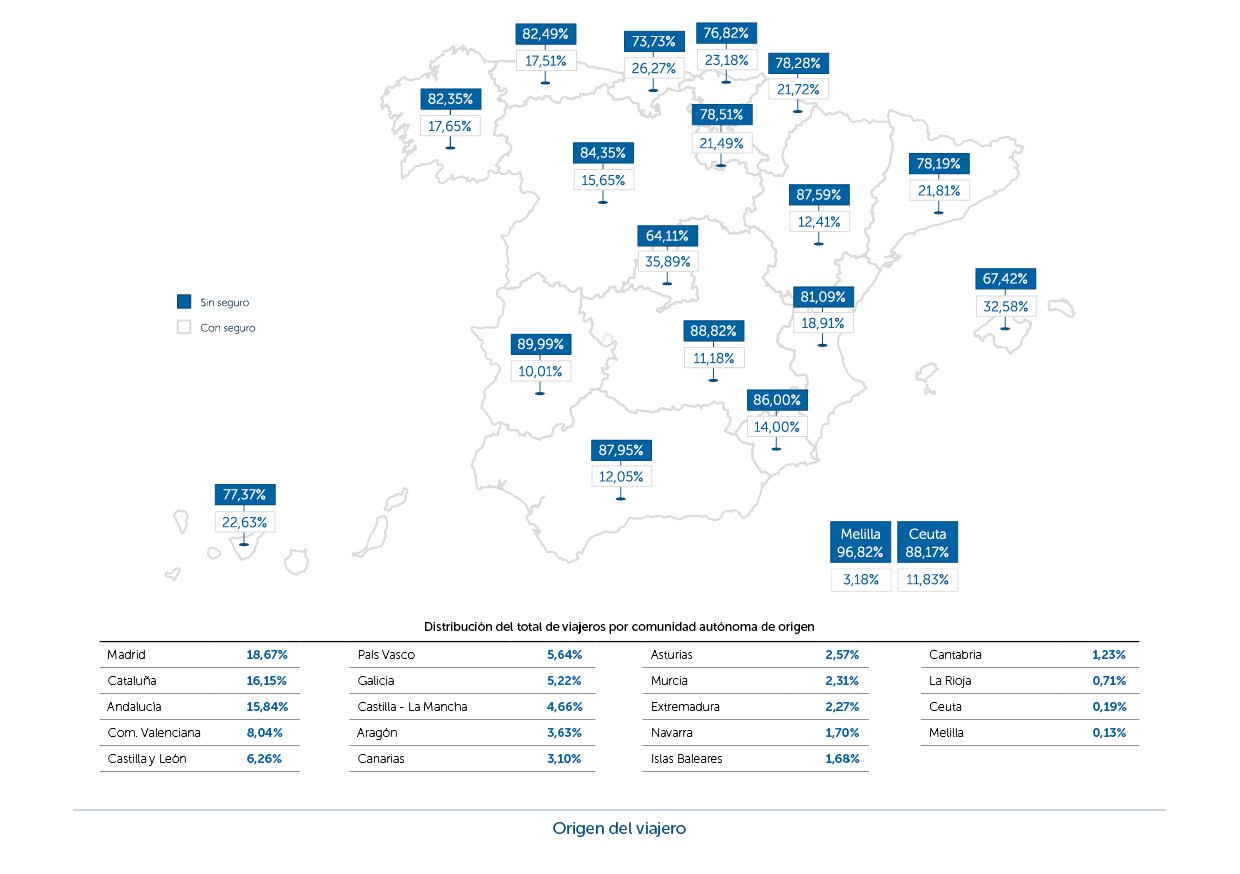
Regarding the traveler's origin, residents of Madrid are the most likely to insure their trips (35.89% travel with insurance; 64.11% without), followed by those from the Balearic Islands (32.58% with insurance; 67.42% without) and Cantabria (26.27% with insurance; 73.73% without). At the bottom of the list are Castilla-La Mancha, Extremadura, and Melilla; in the case of Melilla, only 3.18% of those who travel purchase insurance, placing it well below the Spanish average. These data suggest that Spaniards most likely to purchase insurance live in regions with a high per capita income and those residing on the islands.
Most Spaniards travel as a couple or with family. While families are the population group that purchases the most insurance in absolute terms, in percentage terms, only 18.36% of travelers traveling with their family purchase insurance. For their part, in the case of couples, this figure increases to 23.66%.
Finally, according to the report, insured travelers spend an average of 5 days on trips within the country, 7 days on trips within Europe, and 13 days outside the continent. Regarding the cost of the trip, 64.4% of insured travelers exceed €495.90, the average cost established by the National Statistics Institute (INE).
Travel destination
The destination is one of the determining factors when purchasing travel insurance, with insurance purchases being directly proportional to the distance of the destination. Thus, while only 8.61% of Spaniards purchase travel insurance for trips within Spain—compared to 91.39% who travel without insurance—the figure increases to 31.89% for trips outside of Europe. For trips within Europe, the number of insured travelers accounts for 21.51% of the total.
Thus, the sale of travel insurance in our country is distributed as follows based on the destination: 16.03% for trips within Spain, 33.36% for trips within Europe, and 50.61% for trips outside of Europe. This ratio is inversely proportional to the travel trends of Spaniards, who in 69.17% of cases travel to a domestic destination; in 27.32%, to a European destination; and in only 3.51% of cases, to a global destination.
In addition to destinations where a travel policy is mandatory, such as Cuba and Russia, the country most frequently visited with insurance is the United States. Trips to Asian countries such as Indonesia, Thailand, China, or Japan, other countries in the Americas such as Canada or Argentina, some European Union countries such as Italy, Portugal, and Germany, and countries like Morocco or Australia also account for a large portion of travel insurance purchases.
Although the Ministry of Foreign Affairs and Cooperation recommends traveling with insurance to any country, certain circumstances—such as healthcare systems with particularly high costs for the traveler, very distant destinations involving connecting flights that may lead to luggage issues, or countries with high crime rates or unsafe transportation—are some of the reasons why certain destinations account for the majority of travel insurance purchases. The report analyzes cases such as the U.S., a country where healthcare is particularly expensive: a medical consultation usually costs more than €125, an expense to which the cost of potential diagnostic tests and treatments must be added, with hospitalization potentially reaching a cost of €4,044 per day.
Cost of insurance and reasons for purchasing it
According to the survey of 2,500 Spanish travel agencies for the report, 19.10% of travelers do not purchase travel insurance because they consider it expensive. However, analyzing the average cost of an 8-day trip to destinations such as New York, Lisbon, Paris, or Tokyo reveals that the cost of insurance accounts for only 3.41% of the total cost of the trip.
Regarding the reasons why Spaniards purchase insurance, the survey shows that the main reason travelers decide to purchase travel insurance is the ability to recover their booking costs if they cancel their trip before it begins (31%). In second place, at 26%, travelers who choose to purchase insurance value coverage for issues with luggage and transportation, highlighting the 24-hour assistance service provided by insurers. The third reason (22%) for purchasing travel insurance is the medical assistance expenses included in these policies.
According to the report, Spaniards purchase insurance an average of 48 days before the start of their trip.
Main travel incidents and their management
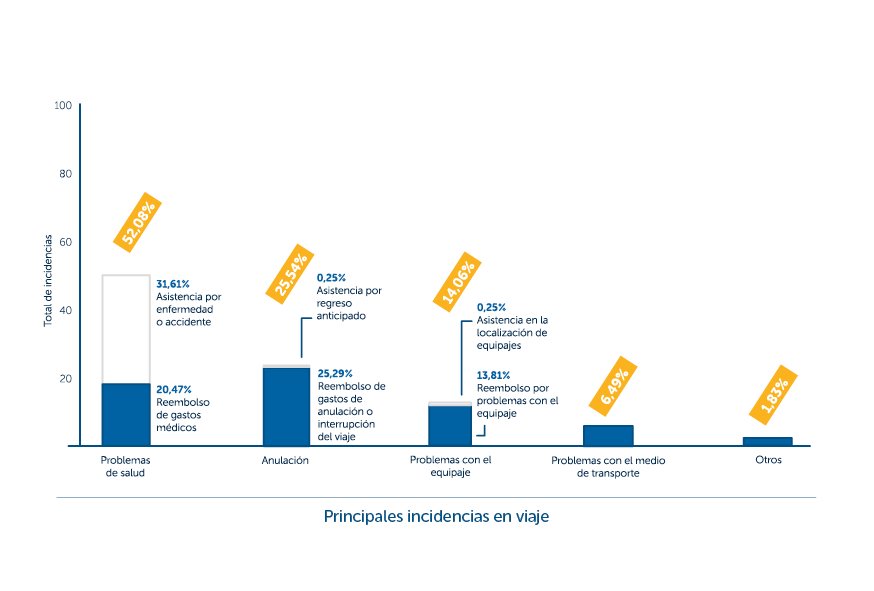
The report from Fundación InterMundial Seguros states that 52.08% of travel incidents are health-related. In 31.61% of cases, the traveler requires assistance from the insurance company due to illness or accident; the remaining 20.47% corresponds to reimbursement claims for medical expenses. Most incidents related to illness are due to cases of fever, ear infections, gastroenteritis, and other minor health issues.
The cancellation of a trip before it begins and trip interruption are the second most common type of travel incident among Spanish travelers (25.54%). Following this in importance are incidents related to luggage, at 14.06%, mostly consisting of cases where the traveler requests a subsequent reimbursement or compensation for damage, loss, theft, or delivery delays of their bags. Finally, transportation-related issues account for 6.49% of cases: these incidents are generally due to delays and missed connections or other services.
According to the data extracted from the report, 72.8% of travelers report an incident on the same day it occursWhen it comes to assistance, incidents are resolved as they occur, and in cases involving reimbursements, 64% of cases are resolved within one month.
When reporting an issue, 76% of travelers contact their travel agency, while only 24% reach out directly to the insurer's assistance center. This behavior is driven by the trust built between the traveler and the agent throughout the trip booking process.
Report preparation
The "Use of Travel Insurance in Spain" report was prepared using 2016 data from InterMundial’s Claims, Technical, and Commercial departments, as well as information gathered through a travel insurance usage survey conducted by InterMundial among 2,500 Spanish travel agencies (both online and traditional).
This report is also based on data from the Resident Tourism Survey, the Passenger Transport Statistics and tourism occupancy surveys from the National Statistics Institute, AENA passenger statistics, RENFE passenger transport statistics, the Ministry of Public Works' Observatory for Coach Passenger Transport, and data provided by the ARAG assistance center, in addition to current legislation and other external documentation detailed within the report.
The report is rounded out by testimonials from tourism sector representatives regarding insurance usage, including the Tourism Board (Mesa del Turismo), the Spanish Confederation of Travel Agencies (CEAV), the Spanish Confederation of Hotels and Tourist Accommodation (CEHAT), the Spanish Airline Association (AECA), TUI Spain, Barceló Viajes, and Destinia.

Intermundial lanza Opcional Senior Premium, un seguro específico para viajes por España, en respuesta al peso creciente del viajero silver en el canal agencia
Ver última ediciónIl ruolo dell’assicurazione di viaggio a supporto di agenzie e viaggiatori in un contesto operativo in evoluzione
La situazione in Medio Oriente, in corso da diverse settimane, e il suo impatto sull’operatività aerea riportano al centro una questione chiave per il settore: come accompagnare in modo efficace il viaggiatore quando rotte, coincidenze e programmi subiscono variazioni improvvise.
Ver última edición